How to Track Employee Attendance Accurately?
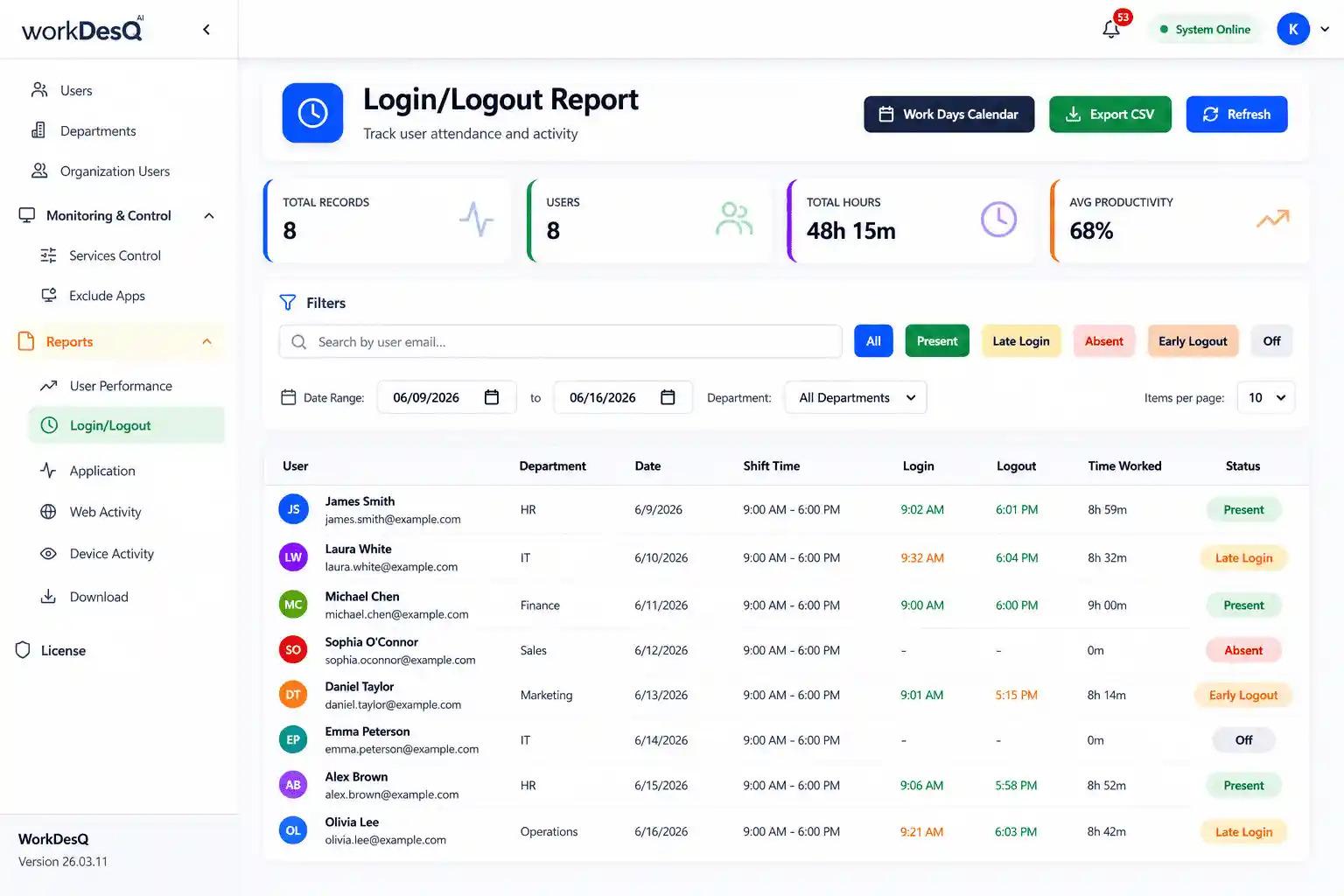
Employee attendance is one of the most important parts of running a business. Whether you have 10 employees or 1,000, knowing who is working, when they started, when they left, and whether they were present on time helps you manage your team better.
Many businesses still use paper registers or Excel sheets, but these methods often lead to mistakes, missing records, and extra work. Modern attendance tracking methods make the process easier, faster, and more accurate.
In this guide, you will learn how to track employee attendance accurately, why it matters, the best methods available, common mistakes to avoid, and how software like WorkDesQ helps businesses maintain reliable attendance records.
If you are wondering how to track employee attendance accurately, follow these simple steps:
- Set clear attendance rules.
- Use digital attendance tracking instead of paper records.
- Track check-in and check-out times automatically.
- Monitor remote, office, and field employees differently.
- Review attendance reports regularly.
- Connect attendance records with payroll.
- Use attendance software to reduce manual errors.
Following these practices helps improve accuracy, saves HR time, and creates fair attendance records for every employee.
Why Accurate Employee Attendance Tracking Matters
Attendance is not just about marking employees present or absent. It directly affects payroll, productivity, workforce planning, compliance, and employee accountability.
When attendance records are accurate, businesses can:
- Process salaries correctly.
- Reduce payroll disputes.
- Know who is available for work.
- Plan employee shifts easily.
- Reduce buddy punching and fake attendance.
- Improve discipline.
- Maintain reliable employee records.
- Make better business decisions.
Even small attendance errors can become costly when they happen every day.
Common Attendance Tracking Challenges
Many companies struggle because they still depend on manual processes.
Some common problems include:
- Employees forgetting to mark attendance.
- Wrong check-in or check-out times.
- Manual data entry mistakes.
- Missing attendance records.
- Fake attendance.
- Difficulty tracking remote employees.
- Late attendance updates.
- Payroll calculation errors.
These problems become bigger as the company grows.
Different Ways to Track Employee Attendance
Businesses use different attendance methods depending on their workforce.
- Paper Attendance Register
This is the oldest method.
Employees sign a register every day.
Advantages
- Low cost
- Easy to start
Limitations
- Easy to manipulate
- Time-consuming
- Difficult to maintain records
- No real-time reporting
- Excel Attendance Sheet
Many small businesses use spreadsheets.
Advantages
- Better than paper
- Easy calculations
- Low investment
Limitations
- Manual updates
- Human errors
- Difficult for large teams
- No automation
- Biometric Attendance System
Employees use fingerprints or facial recognition.
Advantages
- Better accuracy
- Reduces fake attendance
- Fast check-in
Limitations
- Hardware cost
- Maintenance required
- Limited support for remote employees
- Mobile Attendance App
Employees can mark attendance using their mobile devices.
This method works well for:
- Remote teams
- Sales employees
- Field staff
- Hybrid workforce
- Employee Attendance Tracking Software
Attendance software is one of the most reliable ways to maintain accurate records.
It automatically records attendance, stores reports, and reduces manual work.
This is why many growing businesses prefer digital attendance systems today.
How to Track Employee Attendance Accurately: Step-by-Step
Here are practical steps every business should follow.
- Create a Clear Attendance Policy
Employees should know:
- Office timings
- Break rules
- Leave policy
- Late arrival rules
- Overtime policy
- Holiday schedule
Clear policies reduce confusion.
- Use Automated Attendance Tracking
Manual attendance creates unnecessary work.
Automation helps businesses:
- Record attendance instantly
- Reduce mistakes
- Save HR time
- Improve reporting
Automatic attendance also creates consistent records.
- Record Exact Check-In and Check-Out Times
Attendance should include:
- Check-in time
- Check-out time
- Total working hours
- Break duration
- Overtime hours
Complete records provide better visibility.
- Track Different Employee Types Separately
Not every employee works in the office.
You may have:
- Office employees
- Remote employees
- Hybrid employees
- Field employees
Each group needs a suitable attendance tracking method.
- Review Attendance Reports Regularly
Many companies collect attendance data but never review it.
Regular reports help identify:
- Frequent late arrivals
- Absenteeism
- Overtime trends
- Missing attendance
- Shift issues
Reviewing reports every week helps managers solve problems early.
- Connect Attendance with Payroll
Accurate attendance leads to accurate salary calculations.
When attendance records automatically sync with payroll, businesses reduce:
- Salary mistakes
- Manual calculations
- Payroll delays
- Employee complaints
- Keep Attendance Records Secure
Attendance records are important business documents.
Store them safely so managers and HR can access historical data whenever required.
Best Practices for Accurate Employee Attendance Tracking
Businesses with reliable attendance systems usually follow these practices:
- Set attendance rules from the first day.
- Use one attendance system across the company.
- Avoid manual corrections unless necessary.
- Review attendance reports regularly.
- Inform employees about attendance policies.
- Monitor attendance trends monthly.
- Keep attendance records organized.
- Use software instead of paper registers.
Consistency is the key to maintaining accurate records.
Mistakes That Reduce Attendance Accuracy
Many attendance problems happen because of poor processes.
Avoid these common mistakes:
- Using multiple attendance systems.
- Allowing manual attendance edits without approval.
- Ignoring attendance reports.
- Not updating leave records.
- Delayed attendance approvals.
- Using outdated spreadsheets.
- Forgetting remote employee attendance.
- Poor attendance policies.
Fixing these issues improves attendance accuracy significantly.
How WorkDesQ Helps Businesses Track Employee Attendance Accurately
Modern businesses need more than just a simple attendance register.
WorkDesQ helps companies simplify attendance management by providing one platform where HR and managers can monitor attendance records efficiently.
With WorkDesQ, businesses can:
- Record employee attendance digitally.
- Track check-in and check-out times.
- Monitor office, remote, and field employees.
- Maintain attendance history.
- Generate attendance reports.
- Reduce manual HR work.
- Improve payroll accuracy.
- Access attendance data from a centralized dashboard.
Instead of maintaining multiple spreadsheets, HR teams can manage attendance records from one place, making daily operations smoother and more reliable.
Signs Your Business Needs Better Attendance Tracking
Your current attendance system may need improvement if you notice:
- Frequent payroll corrections
- Missing attendance records
- Employees questioning attendance data
- Too much manual work
- Delayed attendance reports
- Difficulty tracking remote staff
- Inconsistent attendance records
- Increasing HR workload
If several of these problems sound familiar, upgrading your attendance process can save both time and money.
Benefits of Accurate Employee Attendance Tracking
When attendance is tracked properly, businesses experience long-term improvements.
Some of the biggest benefits include:
- Better payroll accuracy
- Higher employee accountability
- Reduced attendance fraud
- Improved workforce planning
- Faster HR operations
- Better compliance
- Easier shift management
- Improved productivity insights
- Reliable attendance history
- Better decision-making
Accurate attendance creates a stronger foundation for overall workforce management.
Final Thoughts
Learning how to track employee attendance accurately is essential for every business, regardless of its size. Manual attendance methods may work for very small teams, but they often become difficult to manage as the workforce grows.
By creating clear attendance policies, using automated attendance tracking, reviewing reports regularly, and maintaining secure attendance records, businesses can reduce errors and improve efficiency.
Solutions like WorkDesQ make attendance tracking simpler by helping HR teams manage employee attendance from a single platform. With accurate attendance records, businesses can improve payroll accuracy, reduce administrative work, and build a more organized workplace.
Kategorien
Mehr lesen
New Projects in Kudlu: A Growing Residential Destination for Modern Living New Projects in Kudlu are attracting increasing attention from homebuyers and investors seeking a location that offers excellent connectivity, modern infrastructure, and a comfortable lifestyle. Situated in one of Bangalore's rapidly developing residential corridors, Kudlu has emerged as a preferred destination for...

If you regularly follow Kurdish news, chances are you've searched for Watch MedyaHaber TV Live more than once. Whether you're at home or living abroad, finding a reliable stream isn't always as easy as it should be. Some websites stop working during live broadcasts, while others are overloaded with ads that make watching frustrating. MedyaHaber TV has become a familiar name for many Kurdish...

The Southwest Airlines Headquarters serves as the primary corporate office for Southwest Airlines, overseeing the airline's operations, customer service, and administrative functions. Passengers may contact the head office for assistance with travel-related inquiries, flight reservations, ticket modifications, baggage policies, special travel requests, and other customer support services. The...

Pune is one of India's fastest-growing metropolitan cities, known for its IT industry, educational institutions, and thriving business environment. Every year, thousands of people relocate to and from Pune for employment, education, and personal reasons. During relocation, transporting a vehicle safely becomes an important concern. Professional car carrier in Pune provide a secure, convenient,...

The USA Sterilization Pouch Market is growing steadily due to increasing demand for infection control and sterile medical instruments across healthcare facilities. Rising surgical procedures, strict regulatory requirements, and growing awareness of healthcare-associated infections are driving market growth. The adoption of advanced sterilization packaging solutions and expanding healthcare...