


Create AI Agent: A Step-by-Step Guide to Building Intelligent AI Solutions
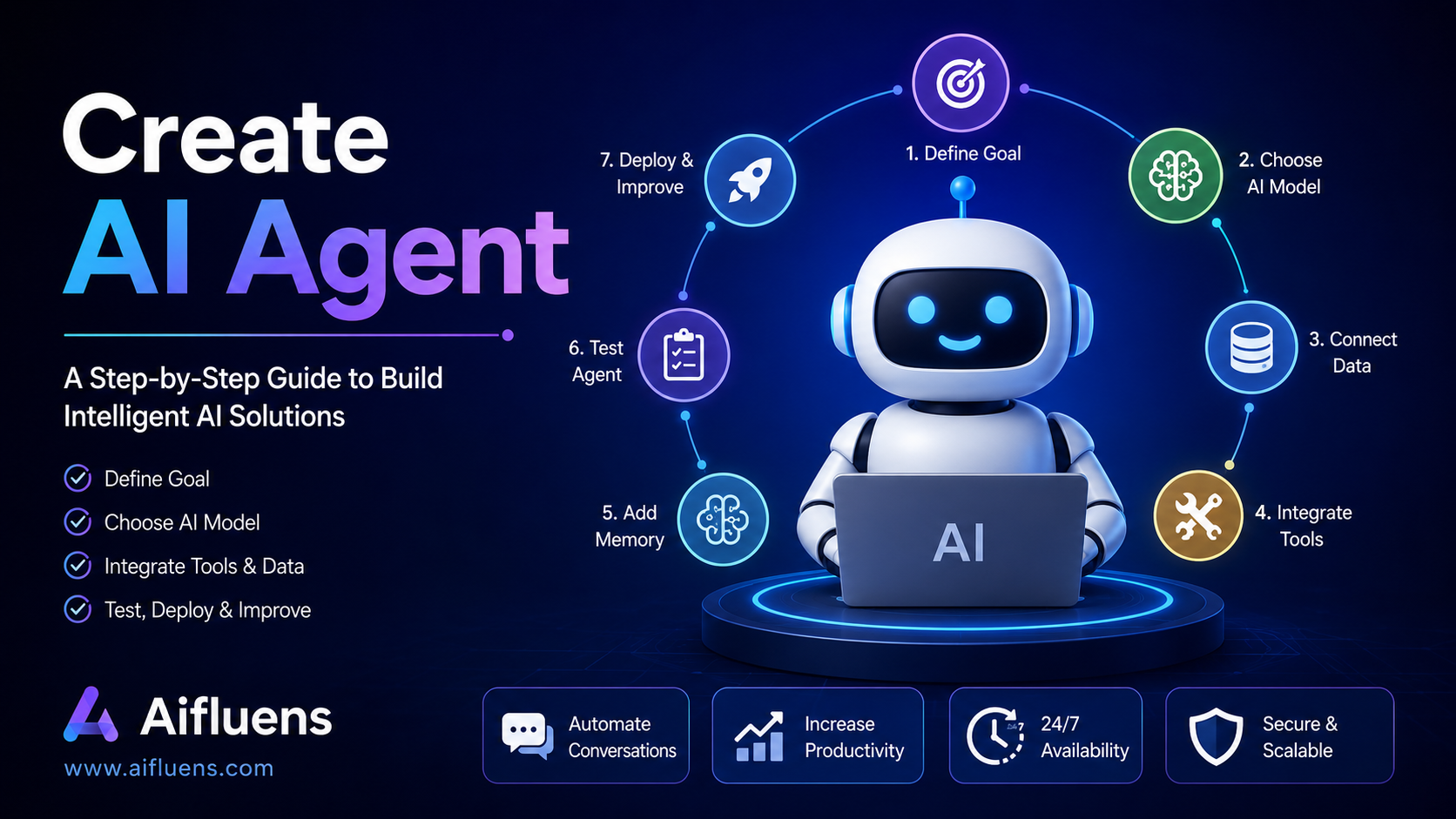
Artificial Intelligence is changing the way businesses and individuals work. From answering customer queries to automating repetitive tasks and analyzing complex data, AI agents are helping organizations improve productivity and make smarter decisions. If you're planning to create an AI agent, understanding the right process, tools, and best practices is essential for building a reliable and scalable solution.
At Aifluens, we simplify AI concepts by providing practical guides, tutorials, and industry insights. Whether you're a developer, entrepreneur, startup founder, or AI enthusiast, this guide will help you understand how to create an AI agent that delivers real value.
What Is an AI Agent?
An AI agent is an intelligent software system that can understand user requests, process information, make decisions, and perform tasks with minimal human intervention. Unlike traditional software that follows predefined rules, AI agents use advanced language models, reasoning capabilities, memory, and external tools to complete complex workflows.
AI agents are widely used in various industries for tasks such as:
-
Customer support automation
-
Content generation
-
Sales and marketing assistance
-
Coding support
-
Research and data analysis
-
Appointment scheduling
-
Workflow automation
-
Personal productivity
As AI technology continues to evolve, AI agents are becoming more capable of handling sophisticated business operations.
Why Create an AI Agent?
Businesses are increasingly investing in AI agents because they improve efficiency while reducing operational costs.
Some key benefits include:
Increased Productivity
AI agents automate repetitive tasks, allowing employees to focus on strategic and creative work.
24/7 Availability
Unlike human teams, AI agents can provide continuous assistance, ensuring customers receive support anytime.
Faster Decision-Making
AI agents quickly analyze data and provide recommendations, helping organizations make informed decisions.
Personalized Experiences
With memory and contextual understanding, AI agents can deliver responses tailored to each user's preferences and history.
Cost Savings
Automating routine operations reduces manual effort and helps businesses optimize resources.
Essential Components to Create an AI Agent
Building a successful AI agent requires combining several technologies that work together seamlessly.
1. Large Language Model (LLM)
The language model serves as the brain of the AI agent. It understands natural language, generates responses, and performs reasoning tasks.
Popular AI models include GPT, Claude, Gemini, and open-source models such as Llama.
2. Memory
Memory allows the AI agent to remember previous conversations, user preferences, and ongoing tasks.
Types of memory include:
-
Short-term conversation memory
-
Long-term user memory
-
Vector database memory for document retrieval
Memory enables more personalized and context-aware interactions.
3. Knowledge Base
An AI agent becomes significantly more useful when connected to reliable information sources.
Common knowledge sources include:
-
Company documentation
-
Internal databases
-
Product catalogs
-
PDFs
-
Websites
-
FAQs
-
CRM platforms
Many developers use Retrieval-Augmented Generation (RAG) to help AI agents access the latest information instead of relying only on pre-trained knowledge.
4. Tools and APIs
Connecting your AI agent to external tools expands its capabilities.
Examples include:
-
Email platforms
-
Calendar applications
-
CRM systems
-
Payment gateways
-
Search engines
-
Cloud storage
-
Project management tools
These integrations enable AI agents to perform real-world tasks beyond answering questions.
How to Create an AI Agent Step by Step
Step 1: Define the Goal
Start by identifying the primary purpose of your AI agent.
Ask questions such as:
-
What problem should it solve?
-
Who will use it?
-
Which tasks should it automate?
A clear objective helps shape the design and functionality of the agent.
Step 2: Select the Right AI Model
Choose an AI model based on factors like:
-
Performance
-
Accuracy
-
Cost
-
Speed
-
Context window
-
Security
-
API availability
The right model depends on your application's requirements.
Step 3: Prepare Your Data
Your AI agent should have access to high-quality, relevant information.
Organize and structure your data before integrating it into the system. Accurate data leads to more reliable responses.
Step 4: Connect External Tools
Modern AI agents often need to interact with software and services.
Examples include:
-
Sending emails
-
Scheduling meetings
-
Creating reports
-
Searching the web
-
Updating CRM records
-
Managing customer support tickets
Tool integration transforms an AI assistant into an intelligent automation system.
Step 5: Implement Memory
Memory helps your AI agent maintain context across conversations.
For example, a customer support AI agent can remember:
-
Customer names
-
Previous issues
-
Purchase history
-
Preferred communication style
This improves user satisfaction and creates more natural conversations.
Step 6: Test Your AI Agent
Before deployment, evaluate your AI agent thoroughly.
Test for:
-
Response accuracy
-
Logical reasoning
-
Speed
-
Error handling
-
Security
-
User experience
Testing helps identify weaknesses and ensures reliable performance.
Step 7: Deploy and Improve
After launching your AI agent, monitor its performance continuously.
Track metrics such as:
-
User satisfaction
-
Task completion rate
-
Response quality
-
API usage
-
Error frequency
Regular updates and user feedback help improve your AI agent over time.
Best Tools to Create an AI Agent
Several platforms and frameworks simplify AI agent development.
Popular choices include:
-
LangChain
-
LangGraph
-
CrewAI
-
AutoGen
-
Flowise
-
n8n
-
OpenAI API
-
Anthropic API
-
Google Gemini API
-
Pinecone
-
Weaviate
-
Supabase
Depending on your technical expertise, you can choose either code-based frameworks or no-code AI agent builders.
Common Challenges in AI Agent Development
While creating AI agents has become easier, developers should still prepare for common challenges.
Hallucinations
AI models sometimes generate incorrect information. Connecting your agent to trusted knowledge sources can reduce this risk.
Security
Protecting sensitive business and customer data should always be a priority.
Cost Optimization
Frequent AI model requests and large context windows can increase operational costs. Efficient workflows help control expenses.
Integration Complexity
Connecting multiple APIs and software systems requires careful planning and testing.
Maintenance
AI agents require regular updates as business processes and knowledge evolve.
Best Practices for Building Successful AI Agents
To create a reliable AI agent:
-
Start with one clearly defined use case.
-
Use accurate and updated data.
-
Design clear prompts and instructions.
-
Add safety guardrails to reduce errors.
-
Monitor performance regularly.
-
Gather user feedback for improvements.
-
Protect user privacy and sensitive information.
-
Optimize workflows for speed and efficiency.
Following these practices helps ensure your AI agent delivers consistent and trustworthy results.
Why Learn AI Development with Aifluens?
At Aifluens, we are committed to making artificial intelligence accessible for everyone. Our platform offers expert tutorials, practical implementation guides, industry news, and actionable insights that help developers and businesses confidently adopt AI technologies.
Whether you're learning the basics or building advanced autonomous systems, Aifluens provides resources that simplify AI agent development and keep you updated with the latest trends.
Conclusion
Learning how to create an AI agent is one of the most valuable skills in today's AI-driven world. Intelligent agents are transforming customer service, business automation, software development, research, and countless other industries. By defining a clear objective, choosing the right AI model, integrating quality data, connecting useful tools, implementing memory, and continuously testing your solution, you can build AI agents that solve real-world problems efficiently.
As AI technology continues to evolve, organizations that embrace intelligent automation will gain a competitive advantage. Whether you're creating your first chatbot or developing enterprise-grade AI solutions, Aifluens provides the knowledge and guidance you need to build secure, scalable, and high-performing AI agents with confidence.
Κατηγορίες
Διαβάζω περισσότερα
Understanding the Importance of Water Control in Construction Water infiltration is one of the major causes of damage in concrete structures and underground construction projects. PVC water stopper is widely used to prevent water from passing through construction and expansion joints in concrete. It creates a strong barrier that protects structures from leakage and moisture related...

Wall panels have become an essential element in modern interior design. More than just decorative accents, they offer practical solutions for enhancing your home's aesthetics, functionality, and overall ambiance. From residential living rooms to commercial offices, wall panels provide versatility, style, and durability. This guide explains the benefits of wall panels, the different types...

Aer Lingus Unaccompanied Minor Policy: A Clear, Simple & Parent-Friendly Guide When a child goes on a trip alone, it can feel both exciting and important. Parents want to know their kid will be safe and feel good while traveling. The Aer Lingus Unaccompanied Minor Policy helps make sure of that. At flyairlinespolicy, we give travel guides that are easy to read. This helps families plan...
