


Octave EAM and Infor OS: What Changed, What Stayed the Same, and What It Means for Your Maintenance Stack
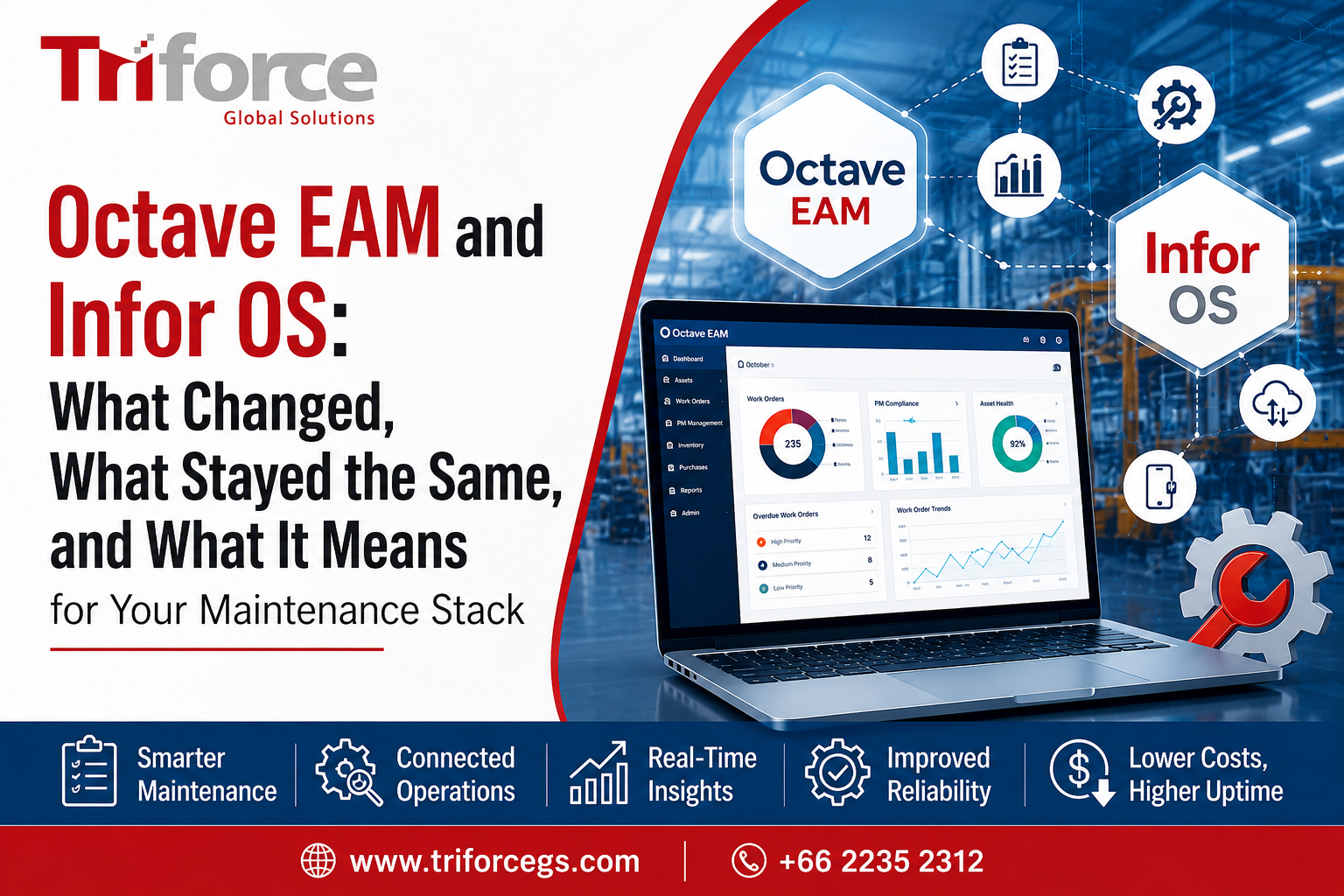
If you've managed maintenance operations for more than a few years, you've probably lived through at least one software rebrand that made you nervous. Your system didn't change overnight, but the name on the login screen did, and suddenly your team is asking whether they need new training, new contracts, or a new vendor relationship altogether. That's exactly where a lot of asset-heavy organizations find themselves right now with Octave EAM.
If you were running Infor EAM a decade ago, then HxGN EAM after Hexagon picked it up, and now you're staring at Octave Attune EAM in your release notes, you're not imagining things. The platform has gone through three names in roughly ten years. What hasn't changed nearly as much is how it sits inside a broader Infor environment, particularly for organizations that still lean on Infor OS for integration, security, and data movement across their ERP and asset systems.
I want to walk through what Octave EAM actually is today, where Infor OS fits into that picture, and the practical questions worth asking before you make any changes to either one.
A Quick History, Because the Naming Actually Matters
Octave EAM started life as Infor EAM. Hexagon's Asset Lifecycle Intelligence division acquired the product line and renamed it HxGN EAM. Then, in a move that confused plenty of long-time customers, that same division spun off as an independent company called Octave, and the product became Octave Attune EAM. Same core software, same underlying architecture, three different names depending on when you last checked in.
This matters for a practical reason: if your organization deployed the platform back when it was Infor EAM, there's a decent chance your integrations, single sign-on, and data pipelines were originally built around Infor's broader ecosystem — including Infor OS. Those connections don't just disappear because the product got a new logo.
What Octave EAM Actually Does
Octave EAM is enterprise asset management software built for organizations that own and maintain physical assets at scale — fleets, plants, utilities, transportation networks, food and beverage facilities, public infrastructure. It covers the full asset lifecycle: work orders, preventive maintenance scheduling, inventory and MRO tracking, labor management, procurement, and compliance documentation like calibration records.
Where Octave EAM tends to earn its keep compared to a basic CMMS is in the depth. A CMMS handles day-to-day maintenance tasks well enough. Octave EAM goes further, managing asset condition over years or decades, tracking depreciation and lifecycle cost, and giving reliability engineers the data to shift from reactive repairs to condition-based and predictive maintenance. Mobile field apps let technicians close work orders and pull documentation from a tablet standing next to the equipment, which sounds minor until you've watched a plant lose an hour of productivity waiting for someone to walk back to a desktop terminal.

Where Infor OS Comes In
Infor OS is not an asset management tool. It's Infor's cloud operating platform — the layer that sits underneath multiple Infor applications and handles the things no single application should have to build on its own: identity and single sign-on, workflow automation, a shared data lake, document management, and integration through Infor's ION middleware.
For organizations running Infor products like SunSystems alongside their asset management software, Infor OS is often the connective tissue. It's what lets a purchase order created in an EAM system trigger an approval workflow and land correctly in the financial ledger without someone manually re-keying data between two disconnected applications. If your finance team and your maintenance team are pulling from the same numbers without a data reconciliation headache every month-end, there's a decent chance Infor OS is doing quiet work behind the scenes.
How the Two Actually Connect in Practice
Here's where it gets specific. Because Octave EAM traces its lineage back to Infor EAM, a meaningful number of current deployments still integrate with Infor OS, particularly where the asset management system needs to talk to Infor SunSystems or other Infor financial and ERP modules. The integration typically runs through Infor's ION connectors, letting asset data, purchase requisitions, and inventory transactions move between systems without a custom point-to-point build that someone has to maintain forever.
That said, this isn't universal. Octave, as an independent company now, is also building out its own integration approach as part of its broader portfolio, and newer deployments — especially ones that never had an Infor ERP in the mix — may not touch Infor OS at all. If you're evaluating Octave EAM today and you're not already an Infor shop, don't assume you need Infor OS to get value out of the platform. It's a legacy connection point for a specific customer segment, not a hard requirement.
What to Actually Check Before You Migrate or Upgrade
A few things worth confirming with your implementation partner or account team rather than assuming:
-
Whether your current Octave EAM version still relies on legacy Infor OS connectors, or whether those have been replaced with Octave's own integration tooling.
-
What happens to single sign-on if you're using Infor OS for identity management and you're moving other systems off Infor.
-
Whether your maintenance data and financial data reconciliation process depends on a specific ION workflow that nobody on the current team actually built or fully understands.
-
How your mobile field apps authenticate, since older mobile deployments sometimes have separate credentialing tied back to the original Infor architecture.
None of this is exotic, but it's exactly the kind of detail that gets missed during a rebrand because everyone assumes it's basically the same system and moves on. It usually is the same system under the hood. The integration layer is where the surprises live.
Conclusion
Octave EAM is a mature, capable platform with a genuinely long track record — it just carries three names' worth of institutional history. If you're already running Infor OS, it's worth a direct conversation with your implementation team about which integration path your instance is actually using before you plan any changes. If you're new to the platform and don't have an existing Infor footprint, treat Infor OS as background context, not a dependency you need to add.
FAQs
1. Is Octave EAM the same as Infor EAM?
They share the same original codebase and lineage. Infor EAM became HxGN EAM after Hexagon's acquisition, and later became Octave Attune EAM when Hexagon's asset lifecycle division spun off as Octave. The core functionality carried forward through each rename, though the product has continued to evolve independently since leaving Infor's portfolio.
2. Do I need the Infor OS to run Octave EAM?
No. Infor OS is not a requirement for Octave EAM. It becomes relevant mainly for organizations that also run other Infor products, like SunSystems, and want a shared integration and identity layer between systems. A standalone Octave EAM deployment doesn't need it.
3. What replaced Infor EAM?
Infor EAM was rebranded to HxGN EAM after Hexagon's acquisition, and it's now marketed as Octave Attune EAM following Octave's spin-off from Hexagon. There wasn't a separate replacement product — it's the same platform under new ownership and branding.
4. Can Octave EAM still integrate with Infor OS through ION?
Many existing deployments that originated as Infor EAM still use Infor's ION connectors for integration with Infor financial and ERP systems. Whether a specific instance still relies on this depends on when it was implemented and whether it's been migrated to newer integration tooling, so it's worth confirming directly rather than assuming.
5. Is Octave Attune EAM available as a cloud-based system?
Octave Attune EAM is offered as a cloud-deployable enterprise asset management solution, alongside on-premises options for organizations with specific infrastructure requirements. Cloud deployment is generally the direction newer implementations take, partly for easier access to mobile and AI-assisted features.
Categorii
Citeste mai mult
تعد شركة تحول ديجيتال واحدة من أهم الجهات التي تقدم حلولًا رقمية متكاملة تساعد الشركات على النمو في العالم الرقمي، خاصة عند دمج خدماتها مع خبرات شركة سيو التي تركز على تحسين ظهور المواقع في محركات البحث. وفي السوق الخليجي بشكل عام، يبرز دور شركة سيو في البحرين كعنصر أساسي في دعم الأنشطة التجارية المحلية وتحقيق انتشار أوسع عبر الإنترنت، مما يجعل التعاون بين هذه الجهات عنصرًا مهمًا لتحقيق النجاح...

Owning a rental property offers excellent opportunities for long-term financial growth, but it also brings ongoing responsibilities. Landlords must market vacant properties, select trustworthy tenants, collect rent, arrange maintenance, and stay compliant with ever-changing housing regulations. These tasks require both time and expertise, making professional rental management an...
Consistent swimming pool maintenance in abu dhabi (atlantapools.ae/services/) separates crystal-clear, safe pools from neglected ones plagued by algae and equipment failure. Many homeowners assume occasional cleaning is enough, only to discover costly problems months later when pumps fail or tiles crack. That's why Atlanta Pools has built a strong reputation across the UAE, combining...

Best Online Cricket ID: A Complete Guide for Cricket Enthusiasts The popularity of online cricket platforms has increased significantly in recent years. Finding the Best Online Cricket ID is essential for users looking for a smooth and convenient cricket experience. A reliable platform provides easy access, user-friendly features, and quality services for cricket enthusiasts. What is the Best...
