


Monsoon 2026 Is Running Late — IMD Update for Delhi, Mumbai & Central India | Latest India Updates
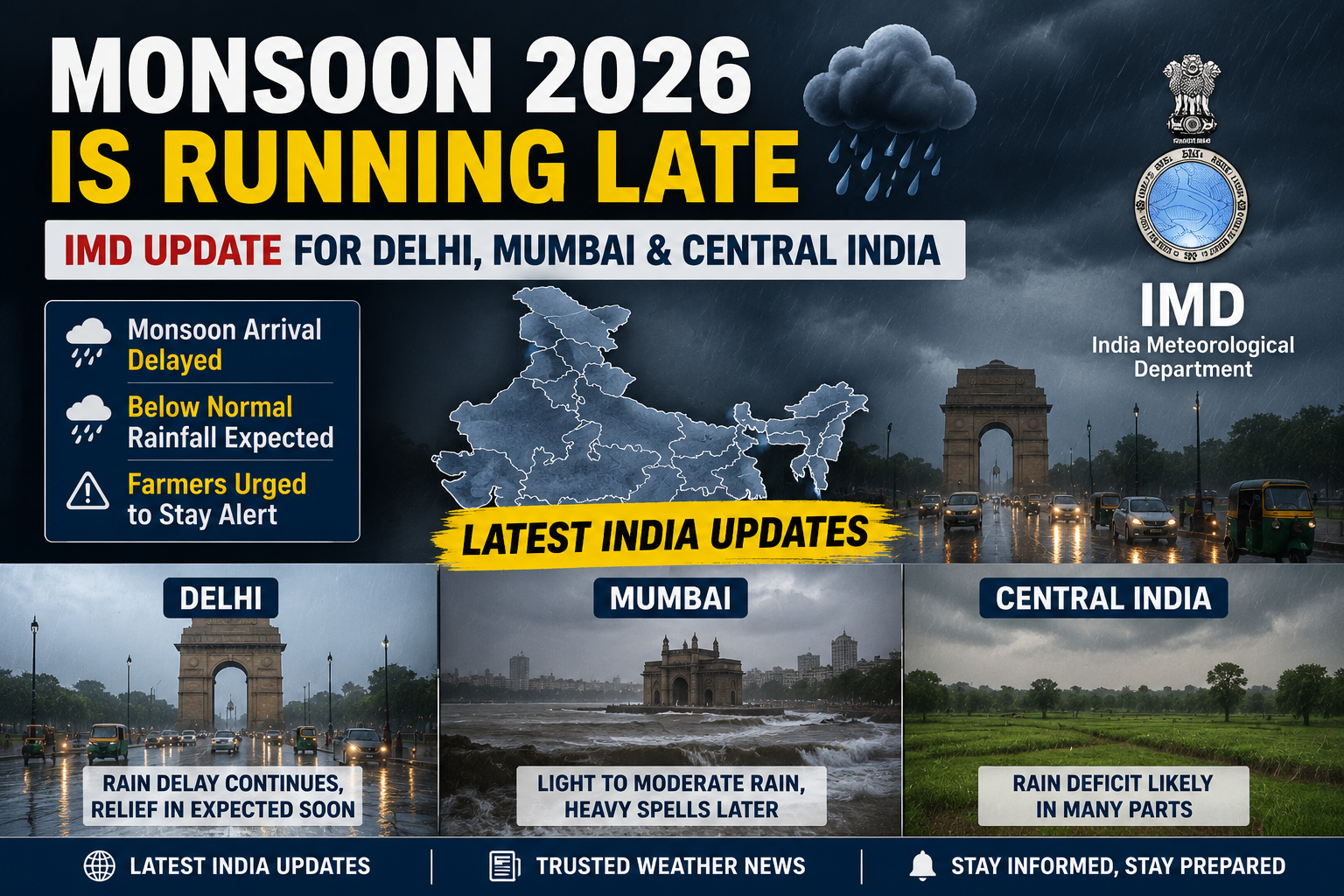
It is the third week of June. The heat is still brutal in Delhi. Mumbai has gone weeks without proper rain. Farmers across central India are staring at dry fields, wondering when to sow.
The southwest monsoon arrived in Kerala on June 4 — a reasonably normal start. But since then, it has been crawling. Large parts of the country are still waiting, and that wait is becoming the biggest weather story in India right now.
If you have been tracking today national news or watching weather updates closely, you already know this monsoon is not behaving the way people expected.
Why Is Monsoon 2026 Arriving Late?
The short answer: the push-and-pull system that drives the monsoon forward has gone weak this year.
Mahesh Palawat, Vice President of Skymet Weather, explained it plainly. "For the monsoon to progress, there should be a weather system developing over the Bay of Bengal, to pull the monsoon from the Arabian Sea. This push and pull system is almost absent this year, which means there is no triggering mechanism for the monsoon," he said.
In simple terms, the atmospheric conditions needed to drag the monsoon northward have not developed strongly enough. Meanwhile, Western Disturbances — a completely different weather system — have been bringing light showers and thunderstorms to Delhi and parts of north India. These are not monsoon rains. They just look and feel like it, which is adding to the confusion.
The desh ki khabrein from across states tell a consistent story: Bihar, Jharkhand, Madhya Pradesh, and Maharashtra are all behind schedule. Even the seasonal rainfall data up to June 10 showed a 26% deficit compared to normal — a significant gap for this early in the monsoon season.
IMD's own long-range forecast, released in late May, had already flagged a warning. The 2026 southwest monsoon seasonal rainfall is likely to be around 90% of the Long Period Average, with an 84% probability of below-normal or less rainfall for the country as a whole. These latest india updates from IMD confirm this is shaping up to be a difficult monsoon year.
What IMD Says About Delhi, Mumbai, and Central India
Let's take it city by city, because the picture looks different depending on where you are.
Mumbai has had one of its driest June spells in over a decade. The monsoon typically reaches the city around June 10–11. This year, IMD had to revise its forecast multiple times — first to June 18–19, then June 22–23, and now the expectation is widespread monsoon showers by around June 25 to late June. A yellow weather alert was issued for June 22 and 23, warning of thunderstorms and gusty winds of 30–40 kmph. Mumbai's seven lakes had fallen to critically low levels, forcing water cut orders across the city.
Central India — covering Maharashtra, Telangana, Odisha, Jharkhand, Bihar, and Chhattisgarh — is the next big area to watch. IMD's press releases from June 17 and 19 both pointed to monsoon advancement into these regions around June 23. That is today national news that farmers and state governments are tracking very closely.
Delhi, Noida, and Gurugram are in a different situation. Historically, Delhi sees the monsoon around June 27. This year, weather experts say that date could slip well into July. The thundershowers Delhi residents have been seeing are caused by Western Disturbances, not the monsoon front. IMD has been clear on this distinction. Live national news from weather bureaus suggests the capital should not expect genuine monsoon rains before the last week of June — at the earliest.
Northeast India, by contrast, is a completely different story. IMD confirmed extremely heavy rainfall over northeast India through June 25, with Sub-Himalayan West Bengal and Sikkim also receiving very heavy rains. The monsoon is thriving there while the rest of the country waits.
How a Delayed Monsoon Can Affect Daily Life
The effects of a late monsoon go far beyond wet or dry weather. They touch almost every part of Indian life.
Agriculture is the first and most obvious impact. India's kharif season — when farmers plant rice, cotton, soybean, maize, and pulses — depends heavily on June rains. Every week of delay compresses the growing season. Hindi samachar outlets from states like MP, UP, and Rajasthan have been reporting farmer anxiety as sowing deadlines approach without rainfall.
Water supply in cities is already under pressure. Mumbai's situation is the clearest example — with lakes at critically low levels and water cuts already in place. Other cities in Maharashtra and central India face similar risks if the monsoon does not arrive soon.
Food prices are the next domino. If kharif output drops because of late sowing or weak rains, vegetable and grain prices could rise sharply by July and August. Markets are watching the situation closely. Some early signs of price pressure on tomatoes, onions, and green vegetables are already visible in hindi samachar reports from retail mandis.
Power demand stays elevated. Air conditioning and cooling loads remain high as long as temperatures don't drop. Power utilities across north and central India are managing higher-than-normal demand heading into what should be the cooler monsoon months.
Transportation — especially in cities prone to flooding like Mumbai — faces its own set of challenges. When the monsoon does arrive after a long dry spell, it can come with intense bursts rather than gradual rain, catching drainage systems off guard.
What Experts Are Watching in the Coming Days
The next seven days are genuinely critical for the 2026 monsoon story.
Weather scientists are watching whether the Bay of Bengal develops an active low-pressure system. That is the key trigger missing so far. If one forms around June 23–25, it could give the monsoon the push it needs to advance quickly into central India and then northward toward Delhi.
IMD's extended range forecast for the period through late June suggests that conditions could become more favourable for rainfall over central and west India. But forecasters are careful not to over-promise, given how many earlier timelines have already been revised.
For farmers, the window for on-time kharif sowing in MP, UP, and Bihar is closing. Agricultural experts say sowing should ideally happen by early July to allow crops enough time before the season ends. If the monsoon reaches these states by June 25–28, there is still time to recover.
Raj Express national news will continue covering all updates on the monsoon's progress, state-wise rainfall alerts, and government responses as the situation develops. Keeping an eye on these updates will be important for anyone whose work, farm, or daily routine depends on the rains.
Why Monsoon Updates Matter for Every Indian
The monsoon is not a weather event for farmers alone. It shapes the entire Indian economy.
About 50% of India's cultivated area is rain-fed. The monsoon directly influences food production, water availability, hydropower generation, and rural employment. A weak or late monsoon puts pressure on all of these at once.
Beyond the economy, the monsoon is deeply personal for millions of Indians. It marks the end of a punishing summer. It fills rivers and wells. It determines whether a village has enough water for the next twelve months.
That is why — from tea stalls in UP to trading floors in Mumbai — people are checking the IMD rainfall update every morning.
Conclusion
The 2026 southwest monsoon is in motion, but it has not yet arrived where most of India needs it. With large parts of central India, Mumbai, and the north still waiting, the coming week will be decisive.
The official IMD forecast, the opinions of private weather agencies, and on-ground reports from across the country all point to a challenging monsoon season — not a disaster, but one that needs close watching.
Readers looking for reliable desh ki khabrein, latest india updates, today national news, and live national news can follow Raj Express national news for regular coverage on monsoon developments, weather alerts, and their impact on India.
The rains will come. The question is how much, how soon, and whether it will be enough.
Catégories
Lire la suite
In today's competitive marketplace, businesses need marketing strategies that create strong visibility and lasting impressions. While digital advertising continues to grow, traditional outdoor marketing remains one of the most effective ways to reach large audiences. A professional Out of Home Advertising Agency helps brands connect with consumers through billboards, digital screens,...

Security has become one of the most important considerations for homeowners, property managers, and business owners. As crime prevention, access control, and property protection continue to be top priorities, investing in reliable security infrastructure has become essential rather than optional. Two of the most effective components of a comprehensive security strategy are professional...
In today's competitive B2B landscape, attracting prospects is only the beginning of the customer acquisition journey. Businesses must guide potential buyers through multiple stages before a purchase decision is made. This process requires a carefully structured marketing funnel that delivers the right message at the right time. One of the most effective ways to achieve this is through B2B...

Introduction When people think about luxury shopping, Dubai almost always comes to mind. The city is filled with glamour, high-end malls, and endless designer choices. But not everyone wants to pay full retail price for a brand-new handbag. That’s where the market for used chanel bags dubai becomes so exciting. Buying pre-owned luxury isn’t just about saving...

The Atlas is one of the most important endgame systems in Path of Exile 2. It provides players with access to increasingly challenging maps, valuable rewards, and opportunities to develop their characters further. However, progressing efficiently through the Atlas often requires more than just skill and persistence. Having the right gear, currency, and resources can make a significant...

