


Fire Alarm Panel or Smoke Detectors?
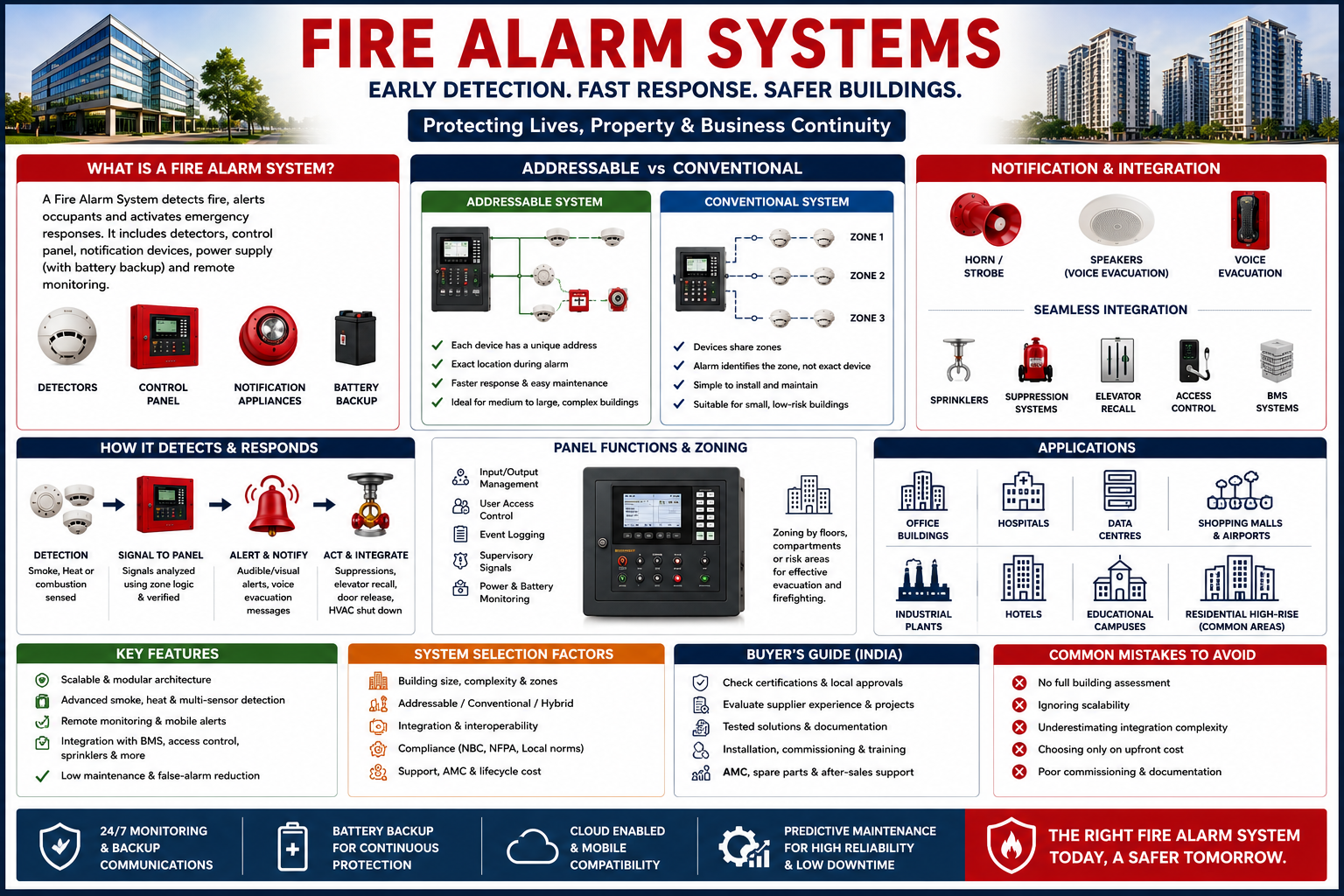
Early detection dictates outcomes in a fire: faster notification reduces injuries, limits property loss, and speeds emergency response. Facility managers, owners, and MEP consultants often ask whether simple smoke detectors suffice or whether they need a full Fire Alarm System. The answer depends on building risk, occupant load, regulatory requirements, and operational continuity needs—especially for commercial, industrial, and critical-infrastructure facilities where life-safety and business continuity are non-negotiable.
What a Fire Alarm System does
A Fire Alarm System is more than a collection of smoke detectors. It comprises detectors (smoke, heat, aspirating, multi-sensor), a control panel, notification appliances (horns, strobes, voice evac), power supplies and battery backup for fire alarm system continuity, interfaces to suppression and access-control systems, and monitoring links to central stations. Together these components detect hazards, verify events, prioritize responses, and coordinate evacuation and suppression.
Detection technologies and when they matter
-
Smoke detectors: photoelectric units excel at smouldering fires; ionization units respond quicker to flaming combustion. Residential house fire alarm system devices commonly use stand-alone photoelectric or combined sensors.
-
Heat detectors: fixed-temperature or rate-of-rise sensors are used where smoke detectors produce nuisance alarms (kitchens, dusty industrial areas).
-
Multi-sensor and aspirating systems: combine inputs (smoke, heat, CO) or draw air samples; essential for data centres, hospitals, and areas needing ultra-early warning.
Addressable vs conventional systems
-
Conventional systems: zone-based, simpler installation, and lower cost; useful for single-family homes or very small commercial spaces with limited risk.
-
Addressable systems: each device reports an ID to the fire alarm system panel, offering precise location, advanced diagnostics, and easier maintenance—standard for commercial fire alarm systems and critical facilities.
Control panels, zoning and notification
A fire alarm system panel applies logic for alarms, supervised faults, and zone control. Commercial panels support complex zoning, phased evacuation, and interfaces for sprinkler pre-action, elevator recall, and door releases. Notification in commercial buildings often uses voice-evacuation and mass-notification strategies; residential systems generally use interconnected horns/strobes or smart home notifications.
Remote monitoring and modern management
Remote monitoring and fire alarm system remote monitoring provide verified alarm transmission to central stations or cloud platforms, ensuring 24/7 oversight. Many systems now offer cloud-based fire panel management, mobile alerts, and predictive maintenance analytics—useful for false-alarm reduction and asset management. When panels are networked, assess cybersecurity controls and maintenance protocols.
Key features to compare
-
Scalable architecture to support future expansion
-
Multi-sensor detection and aspirating options
-
Real-time alerts and mobile integration
-
Remote monitoring and cloud-enabled diagnostics
-
Integration capability with sprinklers, BMS, and access control
-
User-friendly fire alarm system panel interface
-
Predictive maintenance and low false-alarm rates
-
Long operational life and reliable battery fire alarm systems
-
Modular design and 24/7 monitoring for high-availability sites
Applications where a full panel is required
Buildings and facilities that typically require a comprehensive Fire Alarm System include:
-
Commercial office buildings and malls
-
Hospitals and healthcare centres with critical alarms
-
Data centres and server rooms (aspirating detectors)
-
Airports, transit hubs, and high-occupancy venues
-
Industrial plants with process hazards
-
Hotels, educational campuses, government and defence facilities
-
Smart-city infrastructure and critical utility installations
-
Residential high-rise complexes where common-area systems interface with individual home fire alarm system devices
Selection and cost drivers (engineering focus)
Deciding between detectors-only and a full panel should weigh lifecycle value, not just upfront cost. Important factors:
-
Building size, compartmentation, and occupant density
-
Number and type of detection points and zoning needs
-
Required integrations (sprinklers, elevators, access control)
-
Need for remote monitoring, software, and licensing
-
Installation complexity, commissioning, and testing requirements
-
After-sales support, AMC, and spare-part availability
-
Compliance with regulations (NBC, NFPA, and local fire codes)
-
Vendor reputation and interoperability (open protocol support)
Buyer’s guide for India
When evaluating fire alarm system companies and suppliers, prioritise engineering experience and documented project delivery. Confirm testing procedures, compliance certifications, and local approvals. Assess whether the fire alarm system supplier offers installation support, commissioning, training, and robust AMC options. Check product compatibility with existing systems and ask for validation reports for battery backup for fire alarm system performance and remote monitoring capabilities.
Common mistakes to avoid
-
Assuming detectors alone meet code for commercial spaces
-
Neglecting scalability and future-proofing during design
-
Underestimating integration complexity with BMS or sprinklers
-
Selecting equipment based solely on lowest price
-
Skipping proper commissioning and acceptance testing
-
Overlooking cybersecurity for networked fire alarm system panels
-
Failing to plan for maintenance, spare batteries, and AMC
Practical recommendation
For single-family homes or small flats, interconnected smoke detectors and a reliable home fire alarm system may be acceptable where codes permit. For commercial fire alarm systems, high-occupancy buildings, data-sensitive sites, hospitals, or any facility with regulatory obligations, a full fire alarm panel with addressable detectors, centralized monitoring, and integration with suppression systems is the prudent engineering choice. Plan device counts, loop capacities, and battery calculations early in design and include remote monitoring in the acceptance criteria.
For technical design, device selection, and professional installation guidance, consult specialist services that cover comprehensive Fire alarm system installation to ensure the system meets performance, compliance, and operational reliability needs.
Conclusion
Choosing between stand-alone smoke detectors and a full Fire Alarm System is an engineering decision tied to risk, codes, and operational continuity. Commercial and critical facilities generally require addressable panels, supervised circuits, remote monitoring, and system integration to deliver reliable detection and coordinated emergency response. Prioritise validated design, thorough commissioning, and strong after-sales support to protect occupants, reduce response times, and maintain resilient fire safety infrastructure.
Категории
Больше
Air conditioning systems are essential for maintaining a comfortable and productive environment in homes, offices, commercial buildings, hospitals, educational institutions, and industrial facilities. Choosing professional AC maintenance services helps ensure that cooling equipment performs efficiently throughout the year while reducing unexpected breakdowns and expensive repair costs. Regular...

Every day, modern living depletes your emotional reserves significantly. Finding time for self-care when balancing work and personal duties can be a challenge, and over time, this can eventually take a toll on your mental health. Looking after your mental health is no longer a luxury but a requirement for living a healthy life. A pro can be a tremendous ally in helping you find clarity and...

Finding a reliable way to watch Arabic television isn't always easy, especially if you're living outside the Middle East. Many viewers search for the Best Arabic TV streaming app because they want quick access to live news, entertainment, sports, and family programs without depending on traditional satellite television. Today, more people prefer watching television on their smartphones and...
What Makes the Sp5der Sweatshirt Special? The Sp5der sweatshirt stands out because of its bold designs, heavy fabric, and easygoing fit that feels good all day. It’s not just made for comfort—it’s made to get noticed. Think of a regular sweatshirt like plain white rice. It fills you up but doesn’t excite you. The Sp5der sweatshirt? That’s rice with spice, flavor,...

The laptop bag has evolved from a simple protective sleeve into a high-functioning "mobile office" accessory. As the lines between work and life continue to blur, the market is being reshaped by the hybrid work model, the rise of the "digital nomad," and a significant push for sustainable, high-tech textiles. The global laptop bag market size was valued at USD 2,289.7 Million...

