The Growing Impact of AI Workflow Automation on Modern Businesses
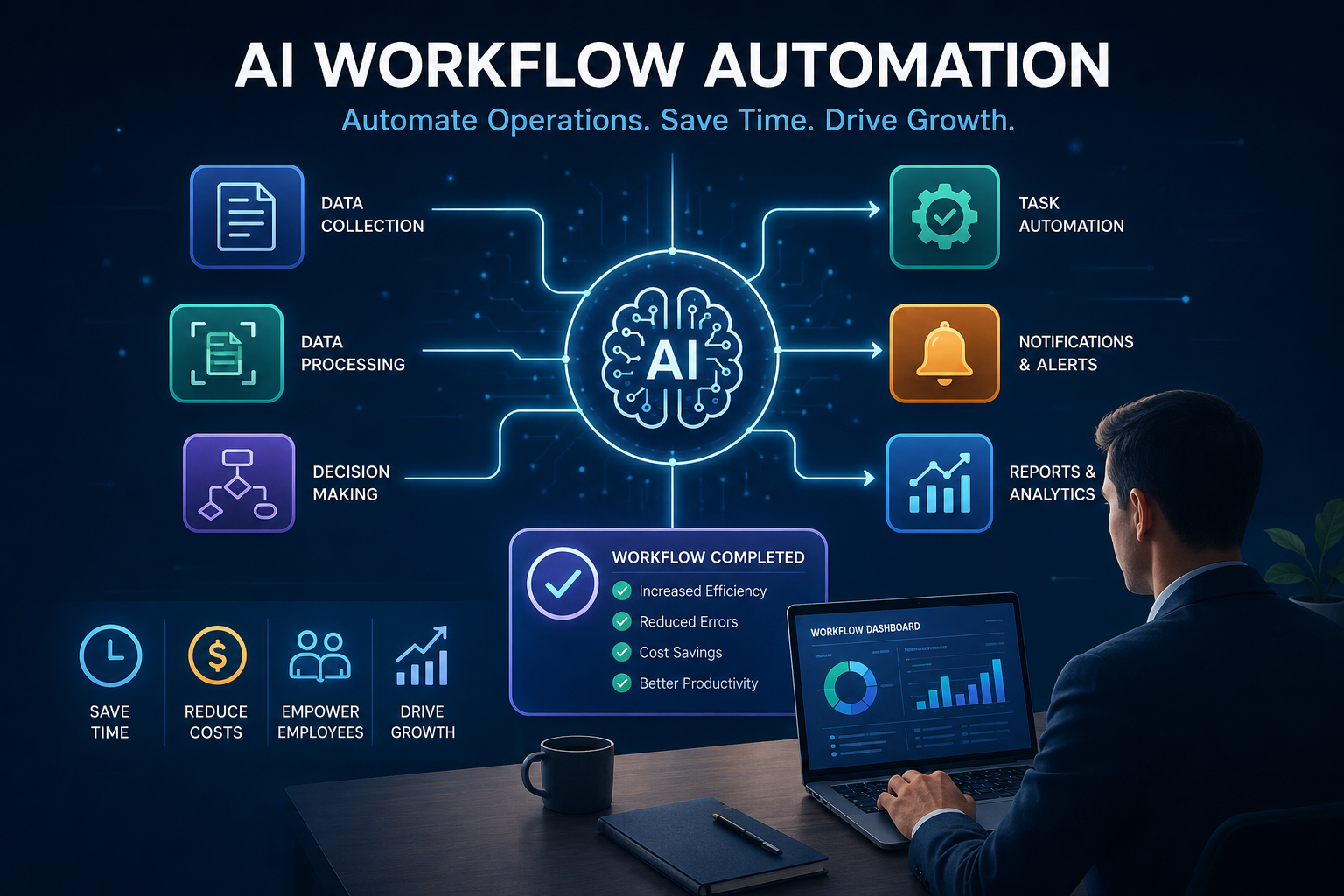
Every successful business starts with ambition. A small team works hard, customers begin to arrive, and opportunities for growth appear. At first, managing daily operations seems straightforward. Tasks are tracked manually, approvals happen through emails, and information is shared across spreadsheets.
Then growth accelerates.
More customers place orders. More employees join the team. More projects require attention. What once felt manageable slowly becomes overwhelming. Employees spend countless hours on repetitive administrative work instead of focusing on innovation and customer service.
This is the point where many organizations begin searching for a better way forward. Increasingly, they are finding the answer in AI Workflow Automation.
When Work Starts Slowing Progress
Imagine a company experiencing rapid growth. The sales team closes new deals every day, customer inquiries continue to increase, and operational demands multiply.
While this sounds like success, it also creates challenges.
Managers spend hours approving requests. Employees manually transfer data between systems. Teams follow up on tasks through long email chains. Small delays begin to create larger bottlenecks.
The problem is not a lack of effort. In fact, employees are often working harder than ever. The issue is that valuable time is being consumed by routine processes that add little strategic value.
As workloads increase, businesses realize they need a way to work smarter, not simply harder.
Discovering AI Workflow Automation
This is where AI Workflow Automation begins changing the story.
Rather than requiring people to manage every step of a process manually, intelligent automation systems can handle repetitive tasks automatically. Information can move between departments without manual intervention. Approvals can be routed instantly. Notifications can be triggered automatically when actions are required.
Instead of spending hours tracking progress, employees can focus on solving problems, improving customer experiences, and driving business growth.
The result is a more efficient organization where work flows naturally from one stage to the next.
The Need to Automate Operations
In today's competitive environment, efficiency is no longer optional. Customers expect faster responses, employees expect better tools, and businesses need greater productivity to remain competitive.
For this reason, many organizations are choosing to automate operations across multiple departments.
Automation helps eliminate repetitive activities that slow teams down. Tasks that once required multiple emails, approvals, or manual updates can now be completed automatically through intelligent workflows.
Businesses that automate operations often experience improvements in:
- Productivity
- Accuracy
- Customer satisfaction
- Employee efficiency
- Process consistency
- Operational visibility
These improvements create a stronger foundation for sustainable growth.
More Time for Meaningful Work
One of the most important benefits of AI Workflow Automation is its ability to give time back to employees.
Many professionals spend a significant part of their day performing routine tasks. Data entry, document management, status updates, and report generation can consume hours that could be spent on more valuable activities.
Automation removes much of this burden.
Instead of focusing on repetitive work, employees can dedicate their attention to innovation, collaboration, and decision-making. Customer service representatives can spend more time helping customers. Managers can focus on strategic planning. Teams can work on projects that contribute directly to business success.
Automation allows people to contribute where they create the greatest value.
Creating Better Business Processes
Every organization depends on processes. Whether it's onboarding employees, processing invoices, managing customer requests, or approving purchases, workflows are essential to daily operations.
However, manual processes often introduce delays and inconsistencies.
With AI Workflow Automation, workflows become more structured and reliable. Tasks are assigned automatically, deadlines are tracked, and information moves smoothly through each stage of the process.
This consistency helps businesses reduce errors while improving overall efficiency.
Employees spend less time chasing updates and more time completing meaningful work.
Data Becomes a Competitive Advantage
Businesses generate enormous amounts of information every day. Customer interactions, operational records, financial transactions, and project updates all create valuable data.
Without effective systems, much of this information remains unused.
AI-powered workflows help organizations analyze data and transform it into actionable insights. Leaders can identify trends, monitor performance, and make informed decisions based on real-time information.
As businesses continue to automate operations, they gain better visibility into how their organization functions and where improvements can be made.
Supporting Growth Without Complexity
Growth is exciting, but it often introduces new challenges. More customers and larger workloads can place pressure on existing systems and processes.
A manual workflow that works well for a small team may struggle as the organization expands.
AI Workflow Automation provides the scalability businesses need to grow confidently. Automated systems can manage increasing volumes of work without requiring significant increases in administrative effort.
This allows organizations to maintain efficiency while pursuing new opportunities.
Instead of growth creating complexity, automation helps simplify it.
Looking Toward the Future
Technology continues to evolve, and intelligent automation is becoming a central part of modern business strategy. Organizations across industries are exploring new ways to improve productivity, enhance customer experiences, and streamline operations.
The future workplace will likely combine human creativity with intelligent systems that handle repetitive tasks automatically.
Businesses that embrace AI Workflow Automation today are preparing themselves for that future. They are creating more agile organizations capable of adapting to changing demands while maintaining operational excellence.
Conclusion
Every business reaches a point where manual processes begin limiting progress. As workloads increase and operations become more complex, organizations need smarter solutions to remain efficient.
AI Workflow Automation offers a practical path forward by streamlining workflows, reducing repetitive work, and improving productivity across the organization. As more companies choose to automate operations, they are discovering new opportunities to grow, innovate, and deliver better experiences for both employees and customers.
The future of business is not about doing more work. It is about creating smarter ways of working, and automation is helping organizations achieve exactly that.
Categorías
Read More
Networking focuses on connecting computers and devices to share data, resources, and services securely. It helps build skills in network configuration, troubleshooting, routing, switching, and security concepts used in real IT environments. The Networking Course in Chennai offered through FITA Academy introduces practical networking concepts that support technical learning. This knowledge...

Agriculture in India faces several challenges, and pest infestations remain one of the biggest concerns for farmers. Insects can significantly reduce crop yields, damage produce quality, and increase farming expenses. To address these challenges, farmers are increasingly adopting eco-friendly pest management solutions like the best pheromone trap for farming in India. Pheromone traps have...

Global Proximity Services Relay for Public Safety Mission‑Critical Push‑to‑Talk Market is experiencing robust growth as municipalities, first‑responders, and emergency management agencies worldwide pursue more reliable, high‑availability voice communication solutions. Accelerating deployments of LTE‑Advanced, private 5G, and satellite‑backed networks are reshaping the way public‑safety agencies...

New Projects in Devanahalli: A Rising Destination for Modern Homebuyers The demand for New Projects in Devanahalli continues to grow as homebuyers and investors recognize the area's long-term potential. Located in the northern corridor of Bangalore, Devanahalli has transformed from a quiet suburban location into one of the most promising real estate destinations. Excellent infrastructure,...