


The Real Cost of Additive Manufacturing: What Most Businesses Overlook
Introduction
Many discussions around additive manufacturing focus on a simple question: How much does a printed part cost? Unfortunately, that approach overlooks the factors that truly determine whether a project is profitable or expensive.
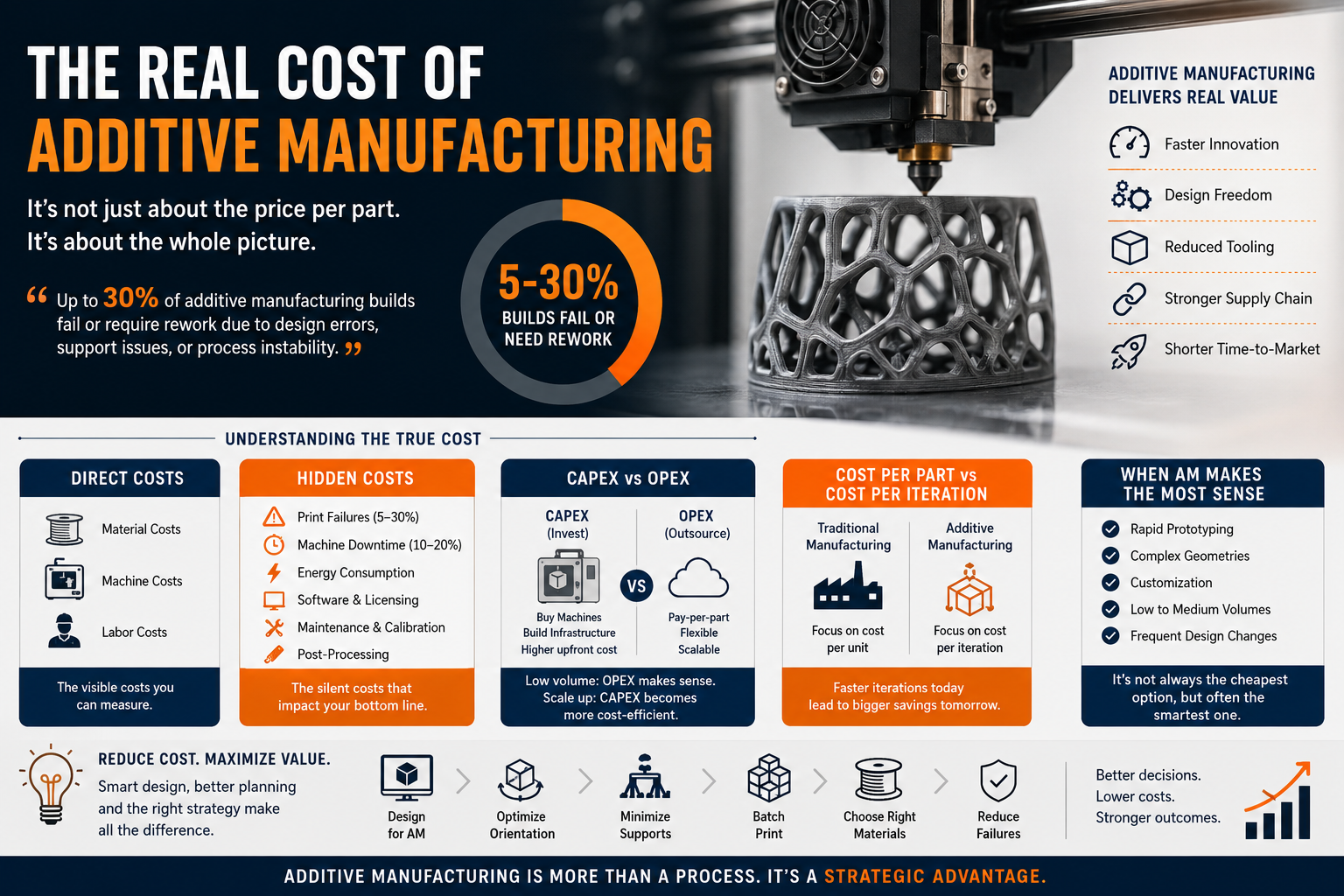
Industry studies frequently suggest that 5–30% of additive manufacturing builds fail or require rework due to design issues, support challenges, or process instability. Yet these losses are rarely included when businesses calculate the cost of 3D printing.
The reality is that additive manufacturing is not inherently cheap or expensive—it is highly strategic. Its value depends on how effectively organizations manage design complexity, production efficiency, machine utilization, material consumption, and post-processing requirements.
As industry expert Terry Wohlers has often emphasized, the greatest benefits of additive manufacturing come from design freedom, faster innovation, and supply chain transformation, not simply lower production costs. When evaluated correctly, a part that appears costly on paper can generate significant savings through reduced tooling, shorter lead times, and faster product development cycles.
Understanding the True Cost of Additive Manufacturing
Most companies focus only on visible expenses such as material usage and machine runtime. However, the total cost of additive manufacturing extends far beyond these direct inputs.
To accurately assess profitability, businesses must evaluate costs from a system-wide perspective rather than relying solely on a cost-per-part calculation.
Direct Costs
Direct costs are the expenses that can be easily measured and tracked:
- Raw materials (filament, resin, nylon powder, metal powder)
- Machine operating and depreciation costs
- Labor for setup, printing, and post-processing
These expenses form the foundation of any additive manufacturing pricing model.
Hidden Costs
Hidden costs often have a greater impact on profitability than direct expenses.
These include:
- Print failures and rework
- Machine downtime
- Energy consumption
- Software licensing
- Equipment maintenance and calibration
- Post-processing inefficiencies
Ignoring these factors frequently results in a significant underestimation of the actual cost per usable part.
CapEx vs OpEx: A Critical Cost Consideration
One of the most important decisions organizations face is whether to invest in equipment or outsource production.
Capital Expenditure (CapEx)
CapEx includes:
- Purchasing 3D printers
- Facility preparation
- Ventilation, power, and infrastructure requirements
Operational Expenditure (OpEx)
OpEx includes:
- Outsourcing to service providers
- Pay-per-part manufacturing
- Material and labor costs bundled into service pricing
For low-volume projects, outsourcing often makes financial sense. However, as production scales, in-house manufacturing may become more cost-effective due to lower long-term operating expenses.
Cost Per Part vs Cost Per Iteration
Traditional manufacturing focuses on minimizing the cost of each unit produced.
Additive manufacturing follows a different model: it optimizes the cost of iteration.
Because no tooling is required, engineers can move through design revisions much faster.
For example:
- CNC-machined prototype: ₹10,000 with a two-week lead time
- 3D-printed prototype: ₹2,000 with a two-day lead time
Even if production costs eventually increase, the ability to accelerate development and shorten time-to-market can generate a significantly higher return on investment.
Primary Cost Drivers in Additive Manufacturing
Material Costs
Material selection directly affects overall project expenses.
Typical material costs in India include:
| Material Type | Cost Range |
|---|---|
| FDM Filament | ₹1–₹5 per gram |
| SLA Resin | ₹5–₹15 per gram |
| SLS Nylon Powder | ₹8–₹20 per gram |
| Metal Powder | ₹50–₹500+ per gram |
Additional material-related costs include:
- Support structures
- Infill density
- Failed builds
- Powder refresh requirements in SLS systems
Many cost analyses overlook powder degradation in SLS processes, which can significantly increase material expenses over time.
Machine Costs
Machine costs are typically calculated through depreciation rather than purchase price alone.
| Technology | Approximate Machine Cost | Depreciation Per Hour |
|---|---|---|
| Desktop FDM | ₹20,000–₹2 lakh | ₹20–₹50 |
| SLA | ₹3–₹10 lakh | ₹100–₹300 |
| SLS | ₹50 lakh–₹2 crore | ₹800–₹2,000 |
| DMLS/Metal Printing | ₹3–₹10 crore | ₹3,000–₹8,000 |
Additional expenses include calibration, maintenance, idle time, and failed production cycles.
Labor Costs
Labor remains one of the most underestimated contributors to additive manufacturing costs.
Pre-Processing Activities
- CAD preparation
- File repair
- Build orientation
- Support generation
Typical cost: ₹200–₹1,000 per job
Post-Processing Activities
- Support removal
- Surface finishing
- Sanding and polishing
- Curing operations
Typical cost: ₹300–₹2,000 per part
In many industrial applications, post-processing can account for a larger share of total costs than the printing process itself.
Hidden Costs That Impact Profitability
Several operational factors significantly affect real-world production economics:
- Failure rates between 5% and 30%
- Machine downtime of 10% to 20%
- Annual maintenance costs of 5% to 10% of equipment value
- Energy costs ranging from ₹50 to ₹500 per build
- Software licensing costs between ₹50,000 and ₹5 lakh annually
Example: Failure Cost Impact
Consider a production run of 100 parts:
- Planned cost per part: ₹200
- Failure rate: 20%
To deliver 100 usable components, 120 parts must be produced.
- Total production cost: ₹24,000
- Effective cost per usable part: ₹240
This demonstrates how seemingly small inefficiencies can dramatically affect profitability.
Additive Manufacturing vs Traditional Manufacturing
Low-Volume Production (1–100 Units)
Additive Manufacturing Advantage
- No tooling costs
- Faster lead times
- Lower upfront investment
Medium-Volume Production (100–10,000 Units)
The most complex comparison zone.
Factors such as geometry, customization requirements, and material selection determine which process is more economical.
High-Volume Production (10,000+ Units)
Traditional Manufacturing Advantage
Processes such as injection molding and CNC machining distribute tooling costs across larger volumes, dramatically reducing per-unit expenses.
Typical Cost Per Part Examples
Simple Plastic Component
- Material: ₹50
- Machine: ₹30
- Labor: ₹70
Estimated Cost: ₹150–₹250
Complex Industrial Component
- Material: ₹500
- Machine: ₹800
- Labor: ₹700
Estimated Cost: ₹2,000–₹4,000
These examples illustrate how complexity, rather than size alone, often drives additive manufacturing costs.
When Additive Manufacturing Delivers Maximum Value
Additive manufacturing is particularly cost-effective when:
- Rapid prototyping is required
- Product customization is essential
- Complex geometries are involved
- On-demand production eliminates inventory costs
- Design changes occur frequently
In these scenarios, the benefits extend well beyond simple production costs.
When It May Not Be the Right Choice
Additive manufacturing can become expensive when:
- Producing very large quantities
- Manufacturing oversized components
- Working with premium materials
- Requiring extensive finishing operations
- Achieving extremely tight tolerances
Selecting the wrong manufacturing method for the application is one of the most common causes of unnecessary spending.
Improving Cost Efficiency
Organizations can significantly reduce costs by:
- Applying Design for Additive Manufacturing (DfAM)
- Optimizing build orientation
- Minimizing support structures
- Batch-printing multiple components
- Selecting appropriate materials
- Reducing print failures through validation and simulation
Small design improvements can often reduce total production costs by 30–60%.
The Real ROI of Additive Manufacturing
Cost alone does not determine value. Return on investment comes from broader business benefits, including:
- Faster product development
- Reduced inventory requirements
- Improved design flexibility
- Simplified assemblies
- Shorter supply chains
A component that costs more to print may still create substantial savings by eliminating assembly operations, reducing logistics expenses, and accelerating product launches.
Conclusion
The true cost of additive manufacturing cannot be captured by a single number.
Material expenses, machine utilization, labor requirements, failure rates, post-processing, and supply chain considerations all influence the final economics of a project. Companies that focus solely on cost per part often miss the broader value that additive manufacturing provides.
The organizations achieving the greatest success with additive manufacturing are not necessarily those pursuing the lowest unit cost. Instead, they prioritize:
- Predictability — understanding the full cost structure upfront
- Flexibility — adapting designs without tooling penalties
- Efficiency — aligning production strategies with business objectives
Ultimately, additive manufacturing is more than a production method. When implemented strategically, it becomes a powerful tool for innovation, operational agility, and long-term competitive advantage.
About Forge Labs
Forge Labs delivers advanced additive manufacturing solutions that help businesses move from concept to production with confidence. By combining technical expertise, optimized design practices, and industry experience, Forge Labs enables organizations to reduce risk, improve efficiency, and maximize the return on their manufacturing investments.
Recognized for providing high-quality 3D printing services across Australia, Forge Labs supports engineers, manufacturers, and product development teams with scalable, production-ready solutions tailored to real-world challenges.
Kategorien
Mehr lesen
A strong and attractive fence can completely transform the look and security of your property. Whether you want more privacy, better safety for children and pets, or a stylish boundary for your garden, professional Garden fence Installation is one of the best investments you can make. High-quality fencing not only improves appearance but also increases the value of your home while...

A funny, brutally honest, and surprisingly useful guide to surviving Delhi’s elite nightlife scene with style, confidence, and zero social disasters. Delhi changes after 9 PM. The traffic somehow becomes more aggressive, valet parking starts looking like a luxury car exhibition, rooftop lounges glow brighter than wedding venues, and suddenly everyone in South Delhi becomes...

The global rigid packaging industry remains a cornerstone of the modern supply chain, providing the structural integrity and protection necessary for the safe transport and storage of products across the globe. Unlike its flexible counterparts, rigid packaging comprised of materials such as metal, glass, plastic, and paperboard offers superior barrier properties against light,...
The global interactive kiosks market is undergoing a structural shift, evolving from static, isolated touchscreens into highly connected, AI-enabled, and data-driven endpoint devices. Prompted by an ongoing global emphasis on digital public infrastructure, labor cost optimization, and the expectation of frictionless customer journeys, interactive kiosks have cemented themselves as essential...

"Dunnage Air Bags Market Summary According to the latest report published by Data Bridge Market Research, the Dunnage Air Bags Market Data Bridge Market Research analyses that the dunnage air bags market was valued at USD 503.00 billion in 2022 and is expected to reach USD 743.16 million by 2030, registering a CAGR of 5.00% during the forecast period of 2023 to 2030. This Dunnage Air...

